Nobu Toshikazu
Memoirs of a GeishaNobu Toshikazu is the president of Iwamura Electric, a company he leads alongside its founder and his close associate, Iwamura Ken. A former Japanese marine, Nobu was severely injured during a bombing near Seoul in 1910 and lost his left arm. His history of military service and his later business success are often recalled together. In the novel, his interest in Sayuri becomes both a personal connection and a possible means of improving her financial prospects: Mameha sees in him a potential bidder for Sayuri’s mizuage.
Identity and Background
Nobu attends a sumo exhibition organized with his help as a guest of Iwamura Ken. He is the company president and a devoted sumo fan. The event takes place in Kyoto, and Mameha brings Sayuri there specifically to meet the two businessmen. Their visit also carries an indirect connection to Sayuri’s past: Iwamura Electric manufactured the heater whose accident killed Granny.
Nobu’s physical condition is connected to his service as a young lieutenant in the Japanese marines. In 1910, during Japan’s annexation of Korea, he accompanied a patrol near Seoul. When the patrol came under attack, he tried to protect his commanding officer by covering him as a shell struck. The officer was killed, and Nobu was seriously injured; later that year, surgery resulted in the loss of his left arm above the elbow. His account is not presented as a private reminiscence by Nobu, but as history Sayuri learns and recounts. The story had become widely known in Japan, where his war service was often discussed alongside his rise in business.
The Sumo Exhibition
At the exhibition, Nobu’s missing arm is concealed by a sleeve folded and pinned to his shoulder. Sayuri initially notices his injuries with alarm, then makes a deliberate effort to engage him rather than remain quietly on the sidelines. When Iwamura Ken asks whether it is her first sumo match, she answers that it is and asks him to explain the sport. Nobu offers to do so, asking her name because the crowd is too noisy for him to hear it clearly. This exchange establishes him as a possible point of contact for Sayuri while showing her effort to turn a formal introduction into an opportunity.
Nobu’s place in the company is also apparent in the exhibition’s public arrangements. The announcer identifies a substantial cash prize as his personal gift, prompting Nobu to object that the money belongs to Iwamura Electric, not to him. Iwamura Ken responds that the gift is the least he can do in view of the great debt he owes Nobu. Nobu accepts the acknowledgment with gratitude, passes the Chairman a sake cup, and drinks with him. Their exchange reveals a relationship shaped by reciprocal respect and obligation: Nobu is not merely the company’s executive but a person to whom its founder considers himself deeply indebted.
Relationships and Financial Stakes
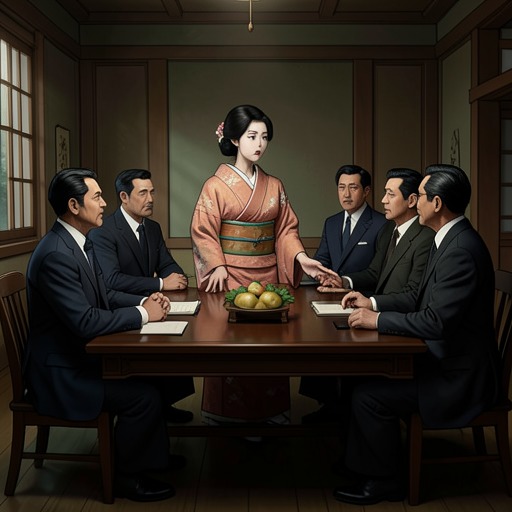
Nobu’s interest in Sayuri becomes important chiefly through Mameha’s interpretation of it. She notices that he seems taken with the apprentice and recognizes a possible parallel with Fujikado, a wealthy self-made businessman who had once competed with Dr. Crab for Mameha’s mizuage. In that earlier contest, the rivalry between bidders helped drive the price unusually high. Mameha reasons that a similar competition could benefit Sayuri, whose troubles with Hatsumomo have made a career built on fame and popularity unlikely.
The plan depends on more than Nobu’s attention. Mameha believes Dr. Crab’s interest must also be recovered: if he remains a potential bidder, his dislike of men such as Nobu could make competition more likely. Nobu’s possible role in Sayuri’s mizuage is therefore strategic rather than established. The evidence shows Mameha considering whether he might bid, not Nobu making a promise or confirming an intention. Her calculation is that interest from two wealthy men could raise the sum available to help Sayuri repay her accumulated debts.
Narrative Significance
Nobu’s story brings together military history, business success, and the economics governing Sayuri’s apprenticeship. His past is introduced through the visible signs of his injuries at the exhibition, then explained as an act of attempted protection during an attack. The narrative thus links his public reputation to both sacrifice and survival without reducing his identity to either his injuries or his heroic history: in the present, he is also a company president, a sumo enthusiast, and a trusted associate of Iwamura Ken.
For Sayuri, Nobu matters at this stage because Mameha sees his apparent attraction as a lever within the mizuage market. The possibility that he might compete with Dr. Crab turns a social introduction into a financial strategy, while the earlier exchange between Nobu and Iwamura Ken establishes that Nobu himself occupies a position of considerable importance. His eventual intentions remain unresolved in this material; what is clear is that Mameha treats his interest as a chance to alter Sayuri’s prospects.